Rewilding cultural imaginations: Reflections from an art exhibition in the forest
How does rewilding speak to you? Why does it matter to you or your community? How can rewilding transform both landscapes and mindsets?
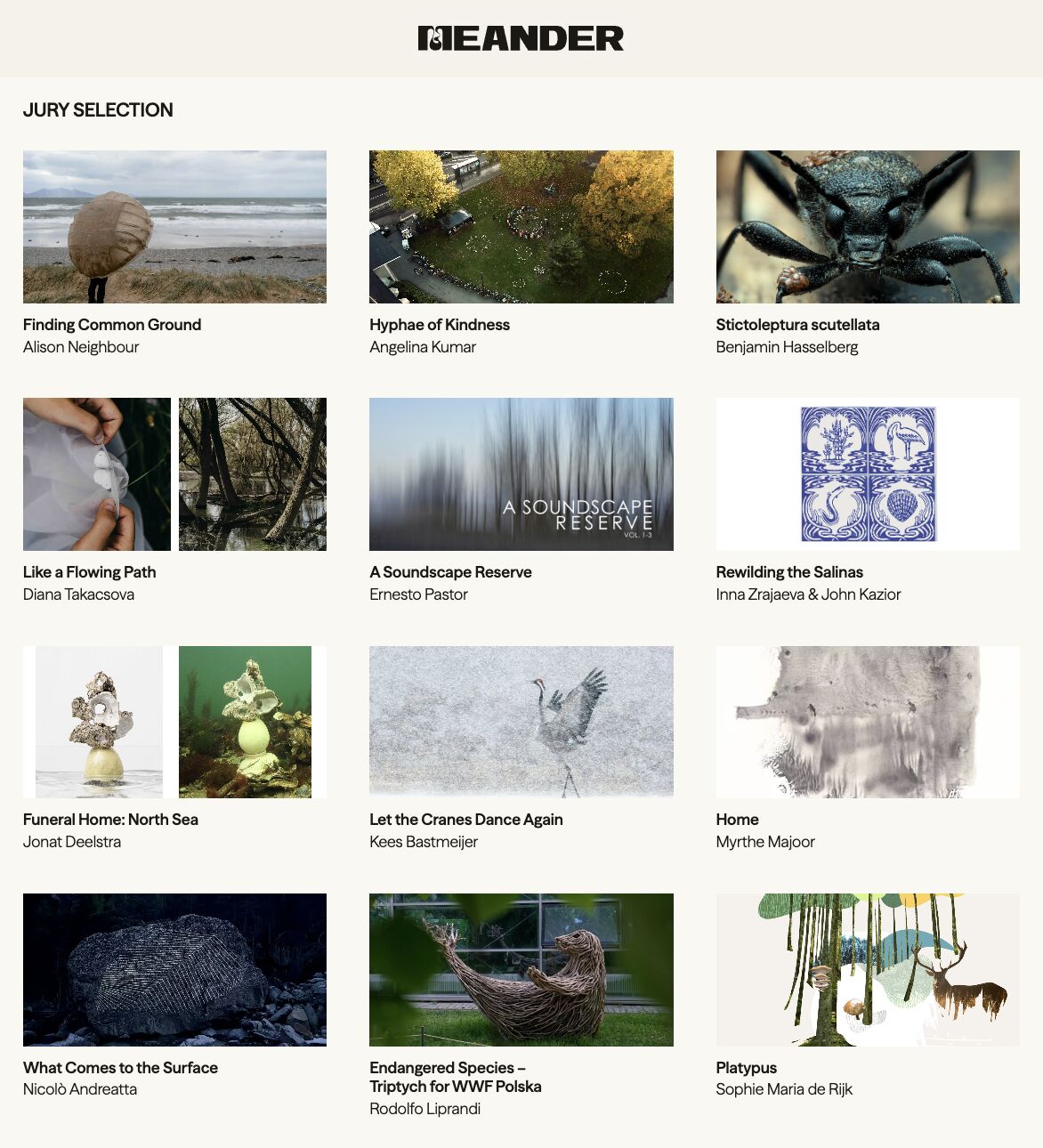
These were the questions we asked ourselves as we started our collaborative “Rewilding through Art” initiative between the WILDCARD and the REWRITE projects. These were also the questions we put forward, to invite anyone with a story, image, or idea about rewilding to share their vision with us. Our goal? An immersive exhibition in the forest with the vision to bridge art, science, and culture. And a virtual gallery with Meander, a new magazine for bioregional culture, slow living, and regenerative futures, who became a collaborating partner along the way.
An invitation that resonated
First of all, it was beautiful to see so many people – artists, citizens, NGOs, researchers – excited about the initiative and sharing the Open Call via their social media channels. Within a few weeks, our LinkedIn account had >200 more followers from several disciplines and fields of work – from rewilding practice to the creative sector. As submissions started coming in, we were even more astonished – there are so many ways to interpret and reflect upon “rewilding”: statues that are being sunk into the ocean, beautiful satellite images of rewilded areas, animal sculptures in real-life sizes created out of forest-based materials, installations in rivers, just to mention a few. While we were hoping to receive between 20 and 30 submissions, we ended up with more than 80 artwork submissions, coming from creatives from 19 countries.
Perspectives in dialogue: the jury
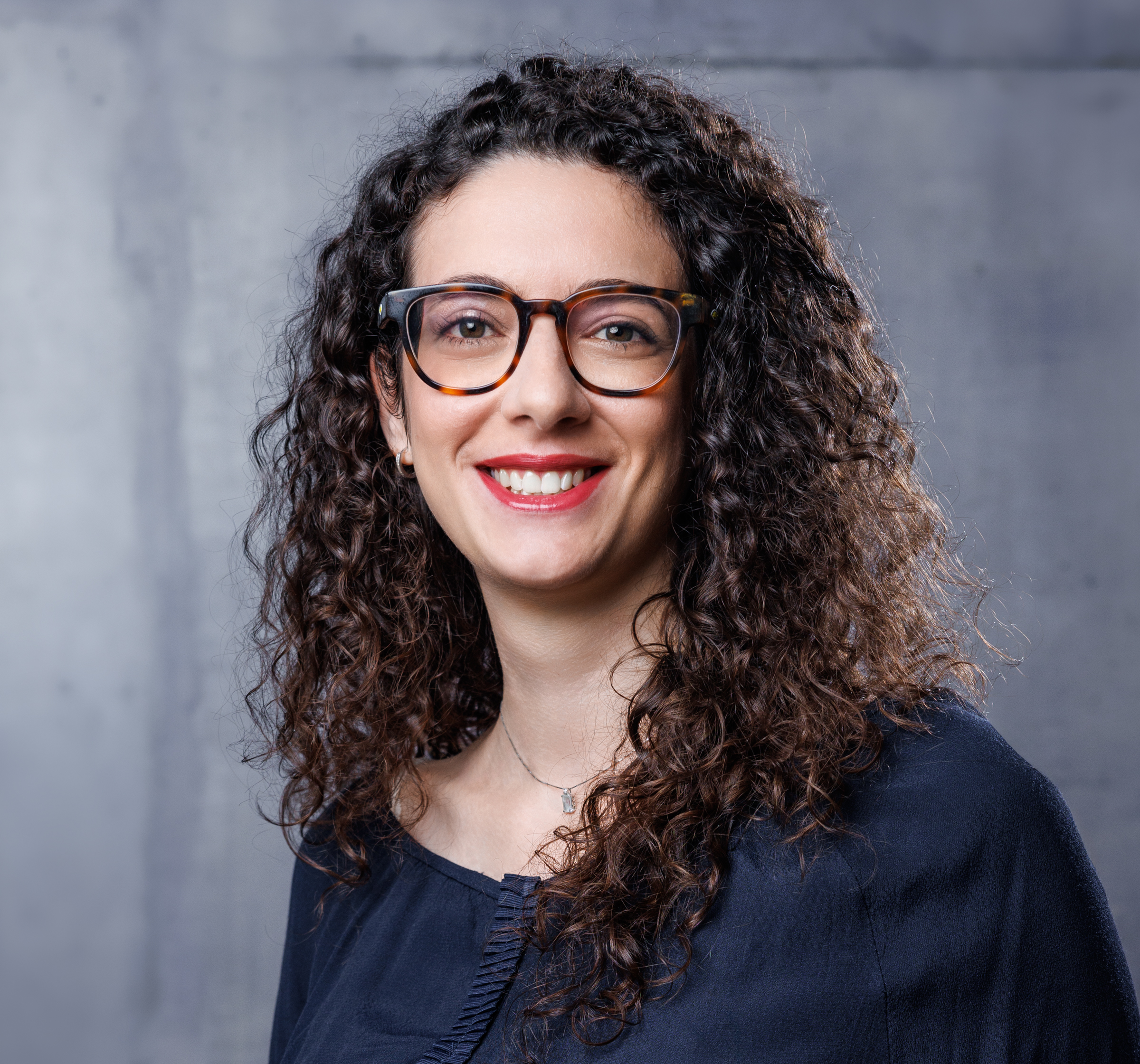
Our jury brought together a remarkable mix of perspectives from art, science, and environmental practice. Evgenia Emets is an artist, poet, and filmmaker whose work explores forests, biodiversity, and community engagement through installations, visual storytelling, and ecological performances. Tom Greenwood, founder and editor of Meander, draws on a background in marine biology and strategic design to connect ecological thinking, regenerative culture, and systems change through his magazine. Giorgio Alberti, Professor of Forest Ecology at the University of Udine and coordinator of the Wildcard project, focuses on forest resilience, carbon dynamics, and climate mitigation. Cintia Organo Quintana, Associate Professor at the University of Southern Denmark and contributor to the REWRITE project, bridges research, teaching, and conservation with her work on plant ecology, biodiversity, and ecosystem restoration. Sara Chiba, consultant and EU project coordinator at Prospex Institute, specializes in stakeholder engagement and bringing diverse perspectives into environmental solutions.
Deciding on the final selection proved extraordinarily challenging. In the end, rather than the planned ten, the jury chose twelve artworks. This decision was not only linked to the exceptional quality of the submissions but also the need to honor the diversity in perspectives and expertise within our jury, ensuring that every voice was able to contribute to the conversation.
From concept to forest floor
However, if we thought selecting was a tough call, we were surprised how much effort it took to actually plan an exhibition in the forest, that was supposed to be part of the “Rewilding Forum” organized by WILDCARD. Permissions from the local forest service had to be granted, proper material needed to be selected, a local printing service had to be found, and a van was rented to bring the artworks to the forest. And easels. Most of us didn’t even know that word in English, but without easels, there would be no outdoors exhibition.
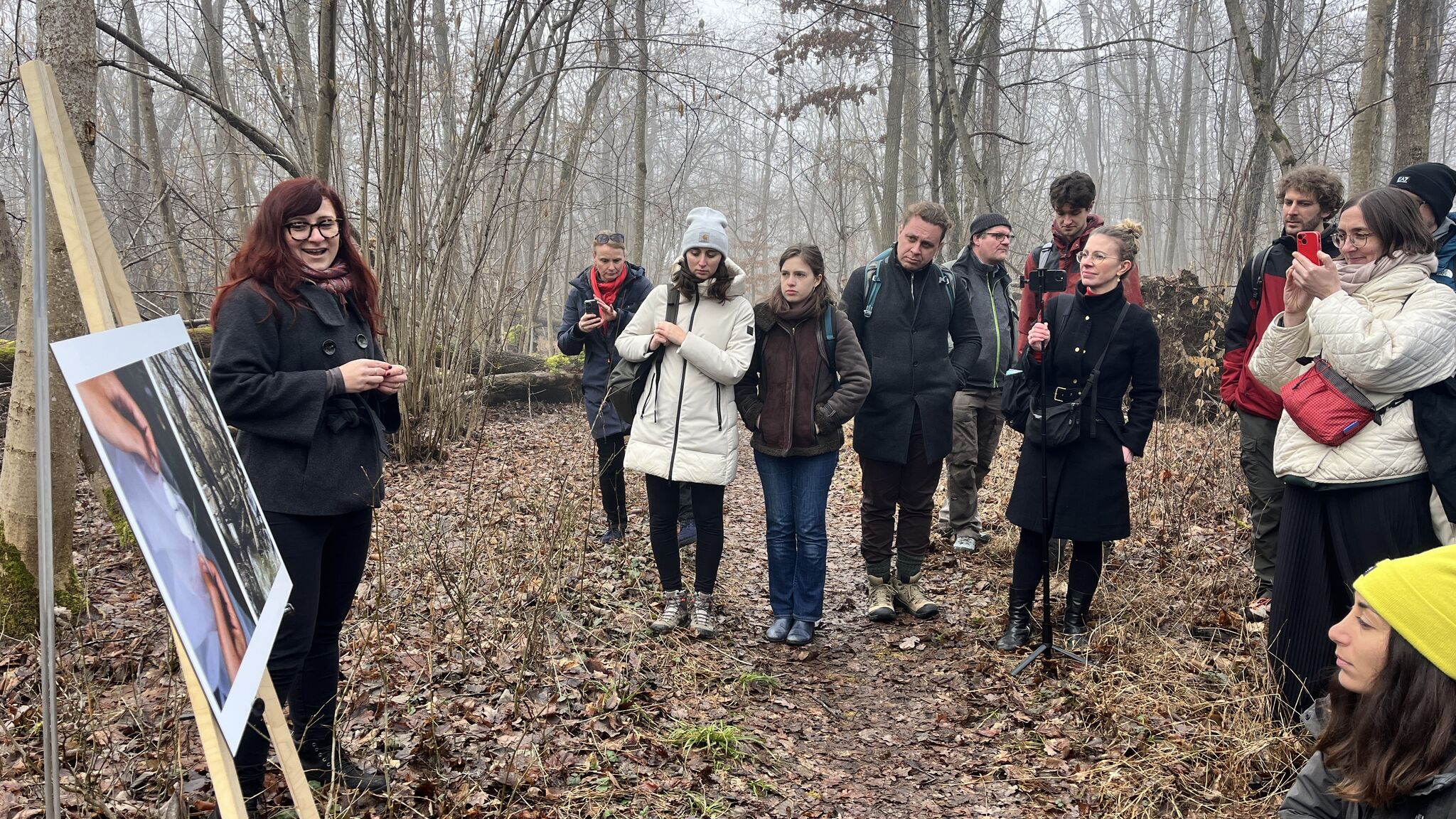
When we – colleagues from Prospex Institute, artist Evgenia Emets, and I – finally stood in the Freising forest on 25th February, it was a moment of pride and excitement. We didn’t notice it was freezing cold (-2 degrees), but we enjoyed the mystical dust in the woods. We didn’t mind carrying the heavy artwork (and the easels) several hundred meters, but we were on a mission to make the careful selection visible – and we expected a big group of around 60 visitors, consisting of rewilding practitioners and scientists, stakeholders from policy, nature conservation, and the creative sector. Setting up the artwork was a muddy experience, but the work looked beautiful in the forest. With us were also three of the twelve artists, that were selected to present their work on the spot, while we had nice introductions prepared for the other artworks and their creators. And then the Rewilding Forum participants came and split into smaller groups to enable a more in-depth exchange.
Walking the exhibition together
Everyone started with visiting the three artists who joined the exhibition to introduce their work: Angelina Kumar, Diana Takacsova, and Inna Zrajaeva, who was representing Feral Malmö, a studio dedicated to reimagining relationships between people and nonhuman nature.
Angelina Kumar was the first to present. She is an artist, researcher and educator whose interdisciplinary practice connects ecology, community, and care. Her participatory sculpture “Hyphae of Kindness,” made from mycelium and fabric, draws on fungal networks to explore reciprocity, kindness and interdependence. When she told us how difficult it was for participants in her work to identify “acts of kindness” for themselves, it was obvious that the forest exhibition group was touched and reflecting about what kindness meant to them. Questions evolved around the contributors to the installation – it was open to the public – and to the knowledge these contributors gathered both about fungal networks and artistic practice. The stakeholder group was impressed with Angelina’s approach of expanding rewilding beyond landscapes to social and emotional renewal through a collaborative, artistic process.
Diana Takacsova was the second presenter. As a research-driven photographer and National Geographic Explorer, she explores environment, identity, and human relationships to place. With her project “Like a Flowing Path” she uses social documentary photography to show ecological restoration and cultural change in Slovakia’s inland Danube delta since 2022. The researchers in the group were interested in her collaboration with the scientists working in the Danube delta, and Diana shared her appreciation of their openness to “invite her into their boat”. She also emphasized how important it is for researchers to make their work visible, and documented it in a visually attractive way to highlight both biodiversity recovery and human stewardship within this transforming landscape.
The third artist was Inna Zrajaeva, representing Feral Malmö. She presented us with a photography of beautiful tiles designed in a Portuguese Art Nouveau style as part of a public workshop hosted at the Aveiro Ceramic Biennial in 2025, called “Rewilding the Salinas”. Inna Zrajaeva explained that during this workshop, participants were invited to paint species inhabiting the salinas today, focusing on four representative species and learning about their ecology through accompanying booklets and discussion with a scientist. Interestingly, we learned from the artist that people were more open to listen while they were painting – which led some Rewilding Forum participants to reflect upon their engagement strategies. We learned that sea pickles should not be harvested intensively, and that the European eel is facing extinction. Through “Rewilding the Salinas,” Feral Malmö highlighted the interplay between art, learning, and ecological awareness. In the Freising forest, Inna invited us to reflect on our role in nurturing resilient ecosystems and celebrating the species returning to these restored habitats.
All other artworks were then presented by us, the people leading the smaller groups of Rewilding Forum participants. While the audience was listening to our speeches and admiring the diverse artwork, we could see that it was not the same as listening to the artists themselves, and we reflected if it would be possible to increase the budget to invite more artists to travel next time.
An immersive space for reflection
What most participants – including myself – realized, is that art has a unique way of opening a reflective space that facts alone rarely manage to do for us. In the quiet of the forest, surrounded by images, stories, and shared curiosity, something shifted: conversations deepened, perspectives widened, and connections formed – between people, disciplines, and ways of seeing the world. What began as an exhibition became a living dialogue, where science met emotion, and knowledge met imagination.
Rewilding, we realized, is not only about restoring landscapes; it is about restoring relationships – between humans and nature, but also among ourselves. Through art, complex ideas can become tangible, and learning can emerge not as instruction, but as exchange. People listened differently and found common ground in unexpected places.
In this space, art did more than communicate – it connected. It invited us to pause, to question, and to imagine other worlds together. And perhaps that is where transformation begins: not only in changing ecosystems, but in rewilding how we think, feel, and relate to one another.
Are you curious to explore rewilding and the selected artworks yourself? The Exhibition Gallery, featuring 12 compelling responses to our Open Call, just launched on Meander magazine with diverse artworks for you to see, sense, and engage with.